Torus
Renlabs · 2025
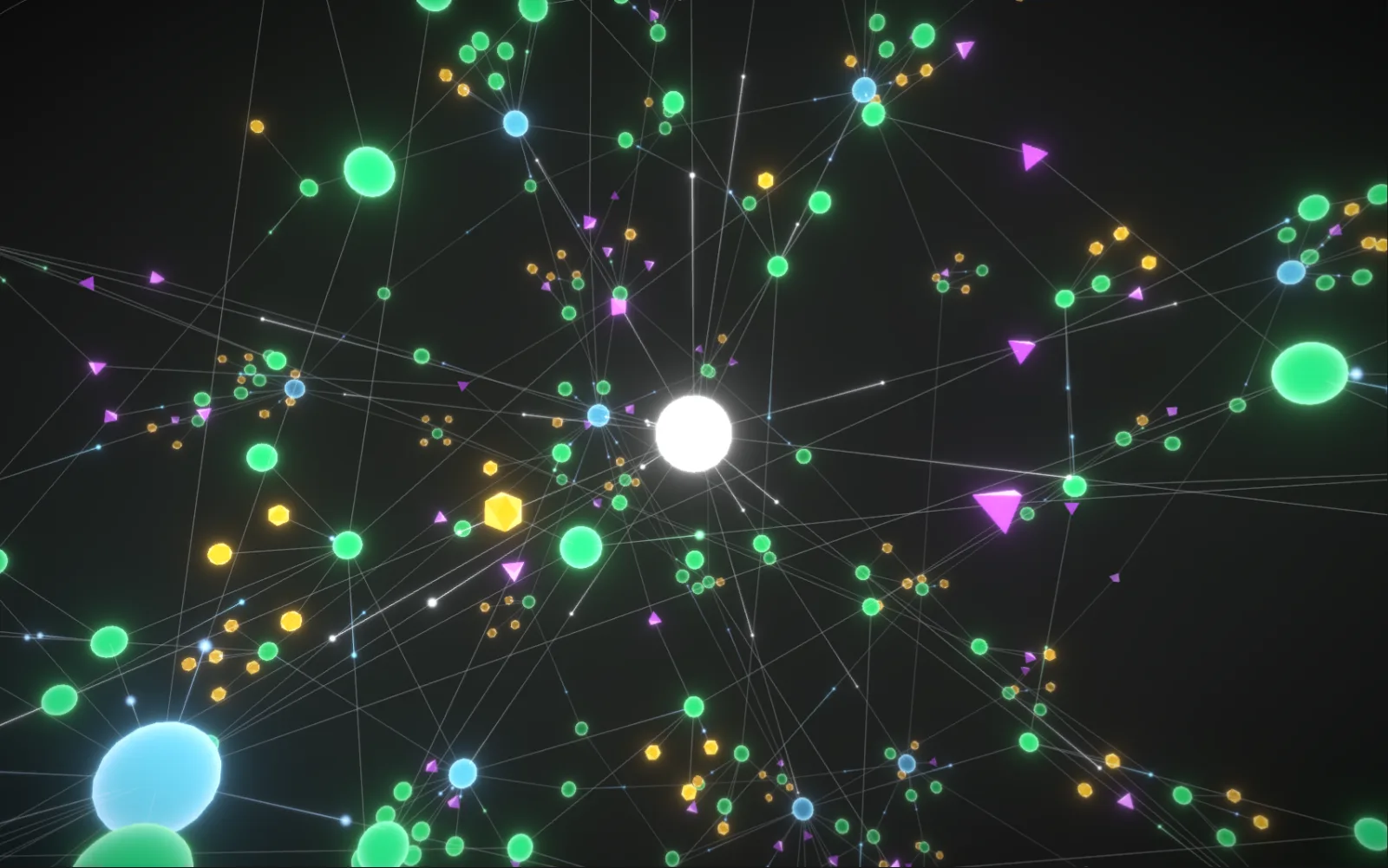
The Torus Portal hypergraph, rebuilt: about 600 agents and permissions arranged by a force simulation.
Overview
This is the hypergraph from Torus Portal, rebuilt for this site. In the original it maps every agent on the Torus network and how emissions flow between them.
The idea
Torus runs on permissions. An agent can grant part of its emissions, or access to a namespace, to other agents. On chain that's rows of account IDs and percentages, and nobody reads those and comes away knowing who depends on whom. We needed a picture people understand before they read anything.
So permissions get their own nodes. One permission can connect a delegator to several agents at once, so it can't be a plain line between two dots. As a node, it's something you can point at and follow out to everyone it reaches. That's what makes this a hypergraph, and it's also what makes it readable.
Spheres are agents, icosahedrons are permissions, tetrahedrons are signals, and the white one in the middle is the root allocator everything hangs from. Here it's all generated from a seed: about 600 nodes and 690 links.
Under the hood
Nobody placed these nodes. d3-force-3d pushes every node away from the others, pulls linked ones together, and runs until the layout settles. Three numbers set the shape: link distance, charge and pull toward the center. I tuned them by eye.
The first version drew it with a graph library that makes a separate object for every node, link and particle: about 830 draw calls a frame. Now I keep the simulation and do the drawing myself:
- Six draw calls. One instanced mesh per node shape, every link in one line buffer, every pulse in one point cloud.
- Pulses on the GPU. The shader works out where each pulse is from the time and its link, so once the layout settles the CPU only advances one number per frame.
- Depth. Nodes and links dim with distance from the camera, so the graph reads as a volume instead of a flat web.
- Glow. Each node has a bright rim that the Bloom pass spreads into the dark. Bloom multisamples at 4× instead of the default 8×, about half the memory for no visible difference.
The scene's code went from 58 KB to 35 KB gzipped, and each frame costs the GPU about a third less.